

50+ talks & workshops
I’ve given 50+ workshops and talks — on AI, well-being, entrepreneurship, pedagogy, and more — for universities, conferences, and teams.
Thanks for visiting my website. I’m an economist who studies happiness, entrepreneurship, and AI — the human (and not so human) side of markets, work, and innovation. My research looks at why people take risks to start new ventures, how work shapes well-being, and how AI, institutions, and luck influence who gets ahead. Across these projects, I’m interested in how business can create better lives.

In 1347 a bored monk miscopied a prophecy, and the doodle in his margin became the Chosen One. Everything he writes comes true. You have no hands, so you shout.
Play it full screen turn the sound on to hear Brother Odo
My research includes over 50 peer-reviewed publications, including a dozen articles in premier journals such as JBV, ETP, JAP, SEJ, and JIBS. My work has been featured in the Economist, Forbes, TechCrunch, the Atlantic, and many other media outlets. I have been honored to receive multiple research excellence awards, including the Habicht Early Career Research Award and the Business for Better World Research Award.
Can’t decide where to start? Just pull the lever.
We like to think success is mostly skill. But what happens when a hundred brilliant, highly skilled people chase the same job, grant, or journal publication? As the gap between their skills shrinks, who wins quietly tips from merit toward luck — the paradox of skill. And now what happens when everyone can use the same AI tool to polish their résumé, paper, or portfolio? Observed differences in skill shrink even further. The more AI makes everyone look alike on paper, the more luck — not merit — decides who actually wins the race. Play with the simulation below to see the effect.
Interactive scatter plot showing how acceptance rate and evaluation noise determine what share of selected applicants would also be chosen on true merit, illustrating the role of luck in extreme selection. A little robot walks along the top of the chart, holding the brush that paints the cutoff.
Each dot is one of 1,500 applicants to an elite pool. The vertical axis is the random luck of their evaluation; the horizontal axis is their underlying skill. The cutoff is a lottery in disguise.
How it works Each applicant’s score is (1−η)·skill + η·luck, and the highest scores get in. The line the robot paints is that cutoff: as the noise rises it tilts from skill toward luck, and AI polish tilts it further.
In the classroom, my passion for innovative teaching has earned recognition from the Academy of Management. I have also received several university-wide teaching awards, including the William H. Fox Teaching Award for Emerging Excellence (Emory University), the N. Preston Davis Award for Instructional Innovation (Colorado State University), the Provost Award for Outstanding Teaching (University of South Florida), and the Innovation in Entrepreneurship Pedagogy Award (AOM ENT Division).

The senior capstone at the College of Business at CSU.

Experimental class on how firms create, capture, and defend value — and how AI is quietly rewriting the playbook for competitive advantage.
Can you earn an A in my class? Let’s see!
Play it full screen sound on, if you dare
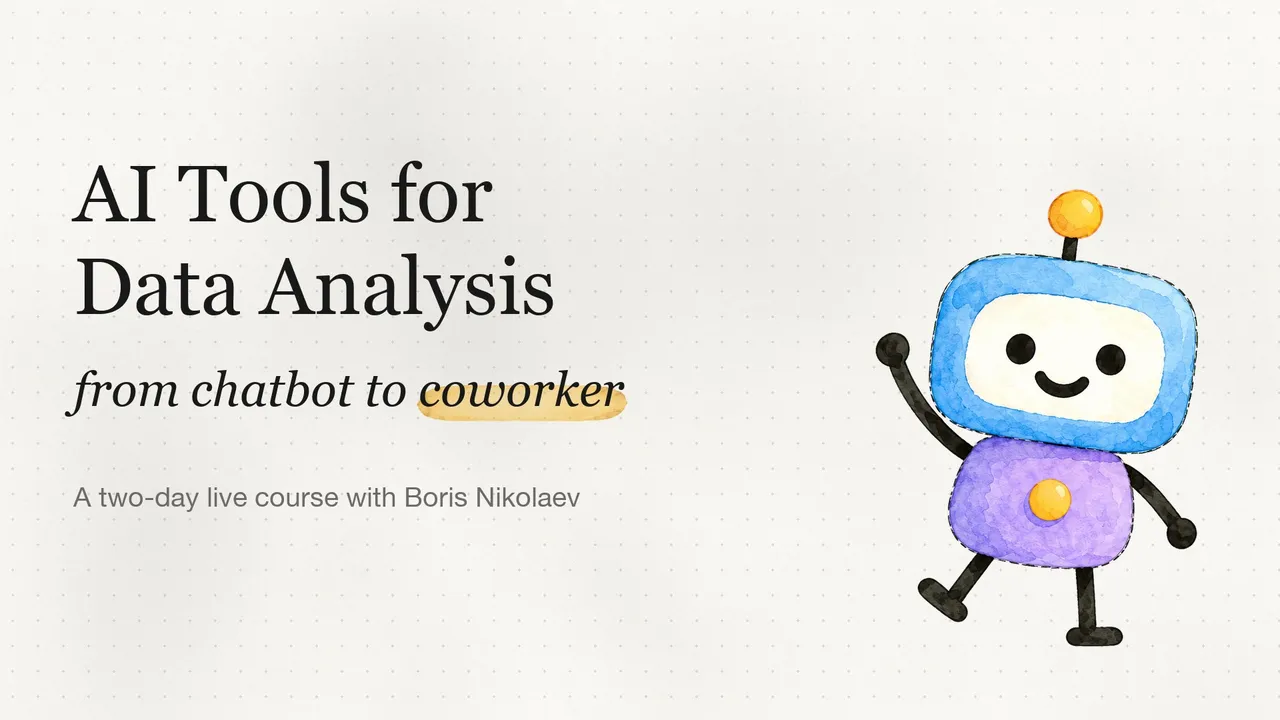
A course I teach for AI Horizons, for anyone who uses ChatGPT or Claude and suspects there’s more. Over two days we hand AI a task, then a project, then a whole portfolio of projects, on real data. The machine writes all the code.
They compete in the AtCoder World Tour Finals. In July 2025, an AI joined them. Run with it to today, and jump into each block to see what happened next.
…interactive dashboards … were invaluable.
“The diversity in applications for using ChatGPT for data analysis, especially the creation of interactive dashboards and HTML to host on a website, were invaluable. Also, the video on LLMs shared in the course materials was excellent and really helped increase my understanding prior to the course.”
…I learned so much new information about what AI can do…
“I have been paying and using ChatGPT since June 2023. I use it every day for research, teaching, and even creative writing, though primarily to code advanced statistical models in Stata, R, and Python. Despite this experience, I learned so much new information about what AI can do and its potential.”
…explained all the topics very well… really interactive.
“I think Boris explained all the topics very well. He knows a lot and was really interactive. I also think that data analysis and AI are very, very important topics that really help our academic career.”
…very relevant and very cutting edge.
“This course was very relevant and very cutting edge. We learned about developments that happened in last 3 weeks.”
…practical examples of how to use AI for data analysis…
“The course provided practical examples of how to use AI for data analysis including how to prompt.”
I regularly work with businesses and organizations to problem-solve and come up with creative solutions.
I’ve given 50+ workshops and talks — on AI, well-being, entrepreneurship, pedagogy, and more — for universities, conferences, and teams.
I advise universities, companies, and organizations on AI and well-being — where the tools genuinely help, how to adopt them wisely, and how it all ties back to people who thrive rather than burn out.
Independent economic and statistical analysis for litigation and disputes — careful, plainly explained, and built to stand up under scrutiny.
Freelance, project-based work — websites, dashboards, and data projects — designed, built, and delivered end to end.
A short engagement or standing advisory, a keynote or a contract analysis — tell me what you’re trying to do.
What do you need? pick any
When? optional
Nothing is sent from this page — the button only opens a draft in your own email app. Or simply write to borisnikolaev@gmail.com.
A few pictures of places I've visited with people I love.
End of the roll.
The rest is in the gallery


